Core components and functions:
The composition of the heavy machinery arc welding workstation must adapt to the welding characteristics of large workpieces. The core modules include:
1. Welding execution unit
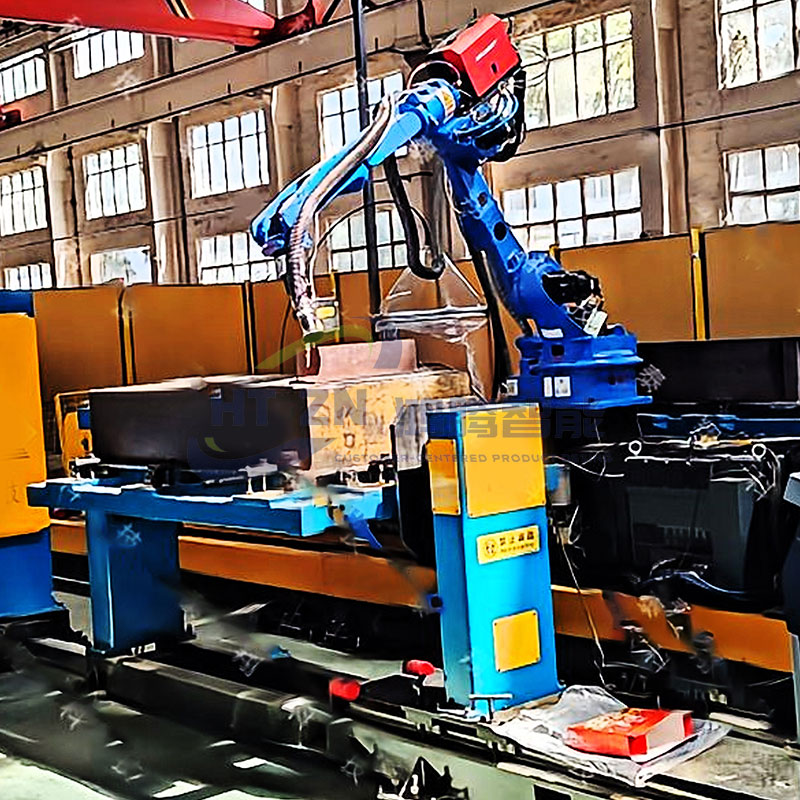
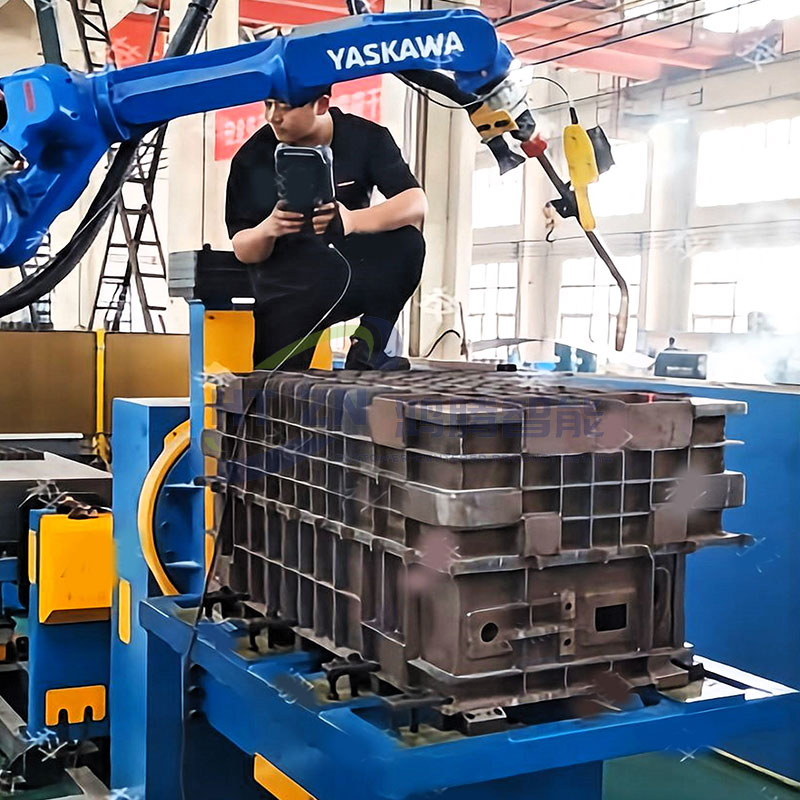
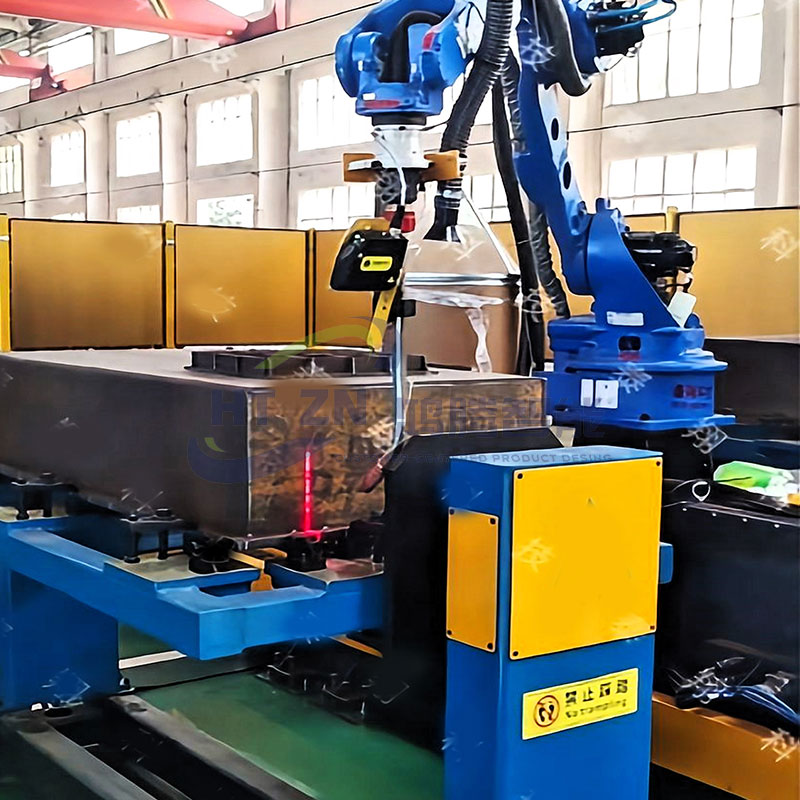
• Welding robot / special machine: mostly 6-axis or 7-axis heavy-duty robots (payload 50-300kg), or customized welding special machines (such as gantry type, cantilever type), to meet the large working radius requirements of large workpieces.
• Welding power source: matched to the workpiece material (mostly low-alloy high-strength steel, wear-resistant steel, etc.) and thickness (usually 10-100mm), using high-power MIG/MAG welding power sources, submerged arc welding machines or flux-cored wire welding machines to ensure deep penetration and high-strength weld seams.
• Wire feeding and shielding system: equipped with a high-stability wire feeder (adapting to thick-diameter welding wire, such as 1.2-3.2mm flux-cored wire or solid wire), as well as a high-flow shielding gas system (such as CO₂, Ar+CO₂ mixed gas), ensuring molten pool protection during thick plate welding.
2. Fixture and positioning system
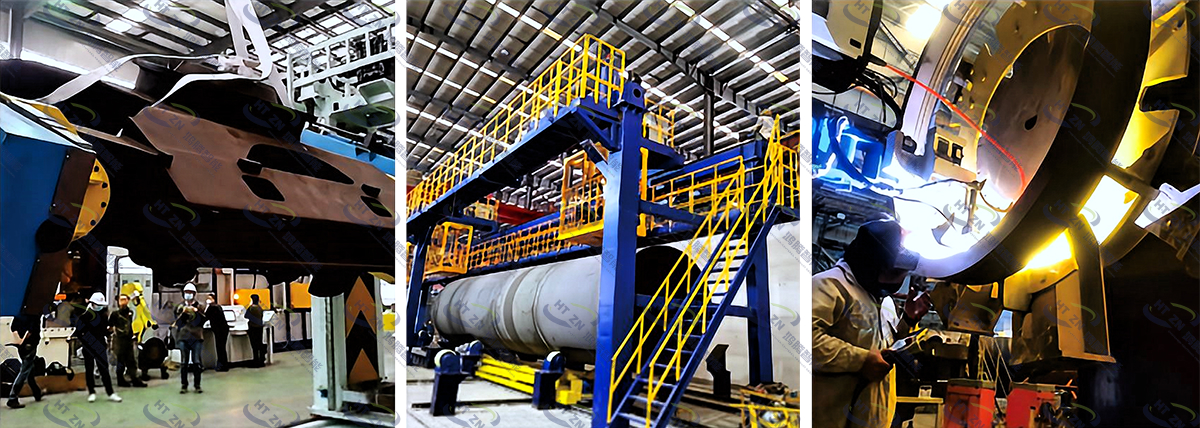
• Heavy-duty fixtures: made of high-strength steel or cast iron, workpieces (such as excavator booms, crane booms) are secured by hydraulic/pneumatic clamping devices, with positioning accuracy controlled within ±0.5mm to avoid dimensional deviations caused by welding deformation.
• Heavy-duty positioner / turnover table: with a load capacity of several tons to dozens of tons, capable of rotating the workpiece 360° or tilting it at multiple angles, adjusting complex weld seams (such as fillet welds and circumferential welds) to flat or ship (down-hand) welding positions to reduce welding difficulty.
3. Control system and auxiliary equipment
• Central control system: integrating PLC, robot controller and welding parameter regulator, supporting offline programming (reducing on-site teach time for large workpieces), capable of storing hundreds of welding programs and adapting to multi-variety production.
• Weld tracking system: using laser vision or arc sensing technology to identify weld seam position deviations in real time (caused by workpiece assembly errors or thermal deformation), automatically adjusting the torch trajectory to ensure consistent weld formation.
• Auxiliary devices: including a torch cleaning and wire cutting device (to prevent spatter from clogging the nozzle), a fume purification system (designed for the heavy fume characteristics of heavy machinery welding, using high-efficiency extraction + filtration modules), and a preheating device (preheating thick plates to 150-350℃ before welding to reduce cold cracking).
Technical features:
Adapted to the welding needs of heavy workpieces
In response to the “thick, large and heavy” characteristics of heavy machinery structural components, the workstation design emphasizes “high load, large stroke and high stability”:
• The output current of the welding power source can reach 500-1000A, supporting single-pass welding or multi-layer multi-pass welding (for example, thick plate welding may require more than 10 layers);
• The fixtures and positioners must withstand welding heat and workpiece gravity to avoid deformation during long-term use.
Strong process specificity
Heavy machinery components generally require weld strength ≥ base material (such as Q355, Q690 steel), and must pass UT (ultrasonic testing) and MT (magnetic particle testing) inspections. The workstation therefore needs to be matched with:
• Low-hydrogen welding consumables (reducing porosity and cracking);
• Interpass temperature monitoring (preventing hardening caused by too-fast cooling);
• Welding deformation control (such as symmetrical welding sequence, forced clamping by fixtures).
Balance between automation and flexibility
Heavy machinery is mostly produced in small batches with many varieties (such as crane booms of different models). The workstation needs to have:
• Rapid changeover capability (modular fixture design, changeover time <30 minutes);
• Robot offline programming (pre-setting welding paths based on 3D models, reducing on-site commissioning time).