|
Welding robot system
|
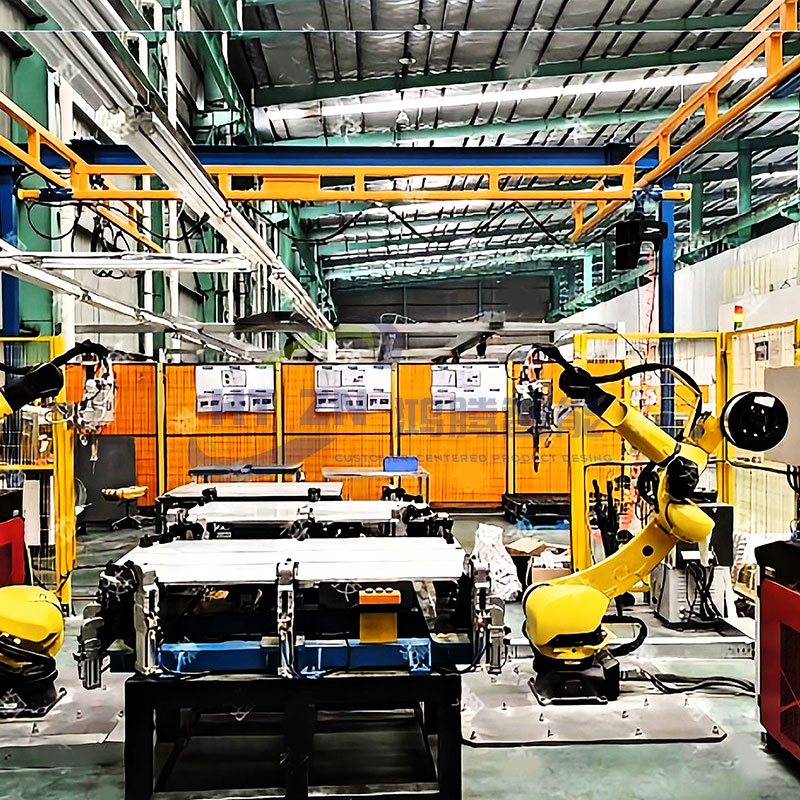
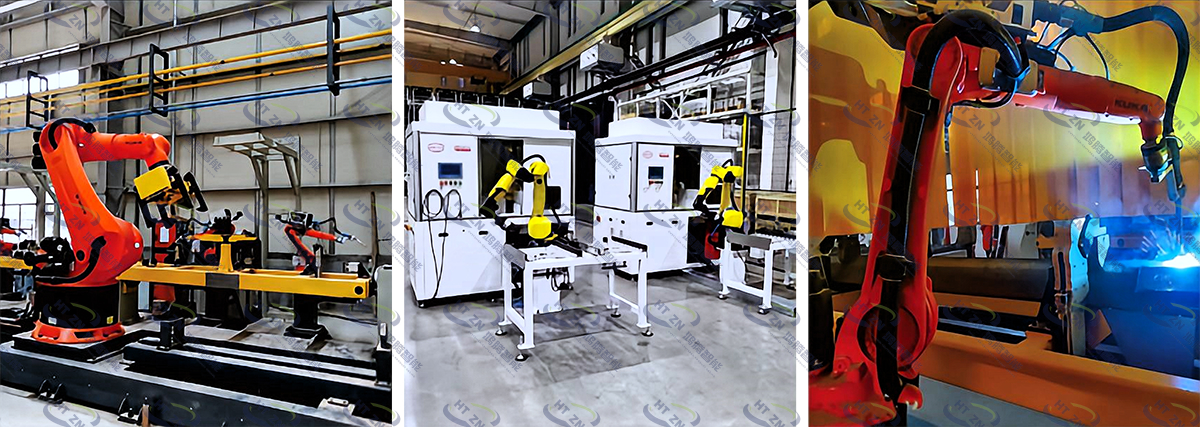
Mostly uses 6-axis industrial robots (optional brands such as FANUC, KUKA, Yaskawa), equipped with a dedicated welding torch to execute the welding trajectory. Some high-end workstations use dual-robot collaborative welding to improve the welding efficiency of large-size trays.
|
|
Welding power source and process module
|
Mainstream use of gas metal arc welding (MIG/MAG) or laser-MIG hybrid welding:
- MIG welding is commonly used for aluminum alloy trays (with Ar or Ar-He mixed shielding gas to reduce porosity);
- MAG welding is commonly used for high-strength steel trays (with shielding gas containing CO₂ to enhance penetration);
- Hybrid welding can increase welding speed (more than 30% faster than pure MIG) and reduce thermal deformation.
|
|
Precision fixtures
|
Used to locate and clamp tray plates, profiles and other components, they must satisfy:
- Positioning accuracy (within ±0.1mm), ensuring post-weld dimensional tolerances (such as total length ±0.5mm);
- Adaptability to material thermal deformation (such as thermal expansion during aluminum alloy welding), offsetting deformation through rigid clamping or adaptive adjustment structures;
- Flexible design (quick switching of fixtures for different tray specifications, supporting multi-variety mixed-line production).
|
|
Positioner
|
Drives the workpiece to rotate or flip (such as a two-axis positioner), keeping the weld seam in a flat or ship (down-hand) welding position, optimizing the welding posture, reducing difficult positions such as vertical and overhead welding, and improving weld quality.
|
|
Weld tracking and vision system
|
Uses laser sensors or 3D vision cameras to identify weld seam positions in real time (especially for complex fillet joints and lap joints), dynamically adjusting the torch trajectory to compensate for offsets caused by workpiece positioning errors or thermal deformation (tracking accuracy can reach ±0.05mm).
|
|
Welding process monitoring system
|
Real-time acquisition of parameters such as welding current, voltage, wire feed speed and shielding gas flow, combined with AI algorithms to analyze welding stability. Once an abnormality occurs (such as wire breakage or insufficient gas), an alarm is triggered immediately and the machine stops to avoid batch defects.
|
|
Auxiliary systems
|
- Fume purification: extraction arms + filters collect welding fumes (aluminum alloy welding fumes contain Al₂O₃ and must be discharged up to standard);
- Cooling system: provides circulating water cooling for the welding torch and power source to prevent high-temperature damage to the equipment;
- Safety protection: fences + light curtains prevent personnel from entering the welding area by mistake.
|
|
Central control system
|
Integrates the control logic of the robot, power source, fixtures, vision and other modules, supporting offline programming (pre-planning welding paths through CAD models), production data traceability (recording the welding parameters of each tray), and adaptation to the factory MES system.
|